Deutsch
PV1000The People's Ventilator
Client
Charity Projekt
Services
Product
User Interface
3D Visualization
WebAR
Risk analysis
Less is more
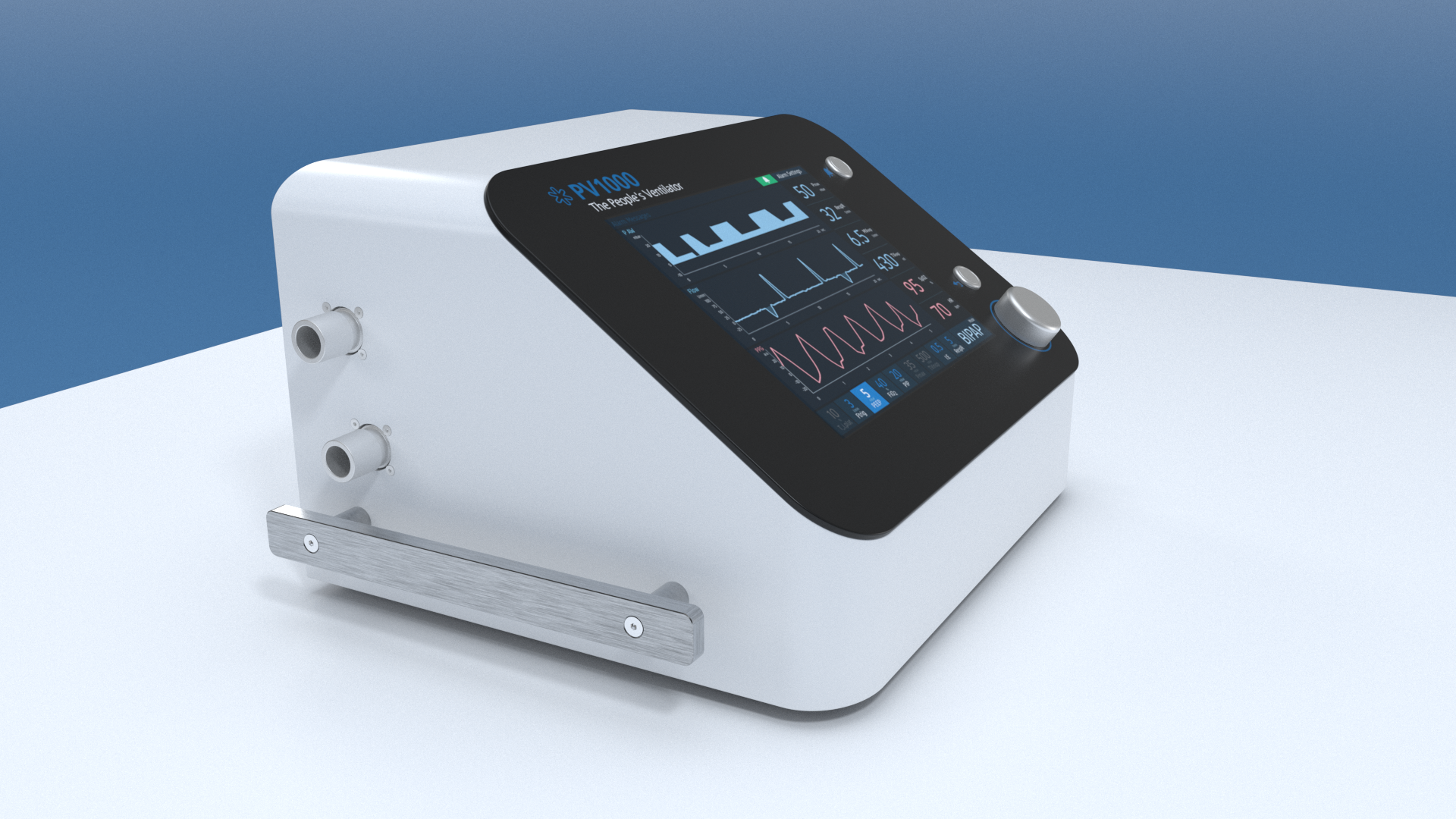
In response to the COVID-19 pandemic, the PV1000 – The People’s Ventilator – was developed as a simple, certifiable intensive care ventilator for worldwide use, particularly to address supply gaps in areas with limited ventilation capacity. The device was consistently designed with a focus on available materials, resource-efficient manufacturing, and intuitive operation. Featuring a click-wheel, two physical buttons, and a large display—deliberately omitting a touchscreen—it meets the requirements for robust and safe operation in intensive care units.
BEGER DESIGN played a key role in the product design, interface and user experience (UX) design, and 3D engineering. Particular emphasis was placed on clear user guidance, a well-organized presentation of all critical ventilation and alarm parameters, and an ergonomic operational logic.
Additionally, the project included the creation of photorealistic visualizations and augmented reality (AR) applications to support virtual product development. Despite the constraints imposed by the pandemic, the PV1000 was developed entirely remotely by interdisciplinary teams of experts; it stands as an exemplary model of successful collaboration and innovative medical technology—”Designed and Engineered in Germany.”
Particular attention was paid to a cost-effective and robust housing design, a simple operating concept, clear user guidance and a clear display of all relevant ventilation and alarm values.
Due to pandemic-related restrictions, the PV1000 was developed entirely remotely by interdisciplinary teams of experts. It is a prime example of successful collaboration and innovative medical technology ‘Designed and Engineered in Germany’.

The PV1000 – The People’s Ventilator is a simple and compact, yet fully-fledged, intensive care ventilator.



Simplicity reliability
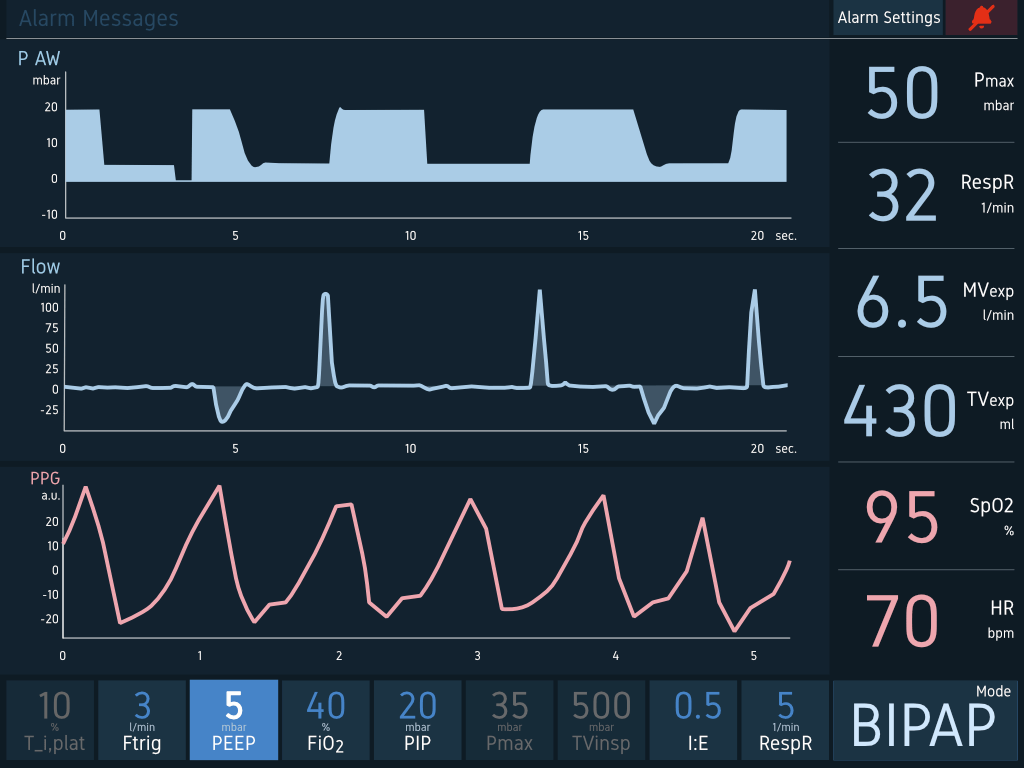
The design of the user interface meets the application’s requirements and is consistently based on the familiar operating structures that users are accustomed to, for example, from DRÄGER.
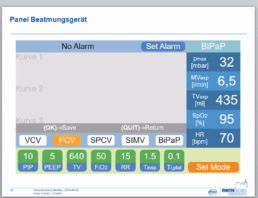
The user interface is characterised by its simplicity and reliability of use. All controls are operated via a click wheel. There are also two buttons: one to mute the arm and another to confirm.

Alle Warnmeldungen sind nach Priorität sortiert übersichtlich in einer Liste zusammengefasst. In einem separatem Menü lassen sich die entsprechenden Alarmgrenzen einstellen und übersichtlich darstellen.


Construction
The PV1000 was designed entirely in 3D at BEGER DESIGN. A key consideration was to design the PV1000 in such a way that it could be manufactured easily and, therefore, cost-effectively. To this end, all internal components are arranged on the base plate.
The device housing is a cast component that can also be manufactured in very small batches. The display does not have a touchscreen, which also helps to keep costs down.

3D Visualisierung
As the PV1000 was available as a 3D data set, we did not use a photography studio to produce the presentation images. We generated the required images using our Maya visualisation software.
Once the PV1000 had been modelled, given materials and textures, and lit, we were then able to generate images from a wide variety of angles.

An Inverse Experience
“With augmented reality, we want to provide our customers with an application that will impress their customers – one that enables them not only to see a product, but to experience it.” We do not view augmented reality as a gimmick, but as a marketing and sales tool that creates added value for businesses and their customers.
It was important to us to involve the future user in the design process. To this end, we make use of the possibilities offered by augmented reality. Augmented reality applications allow the viewer to visualise objects in three dimensions using their own smartphone, wherever they happen to be. The viewer can move around the object or, with a swipe of their finger on the screen, move it back and forth or rotate it. This gives them a good impression of the device and its dimensions.


Optimised for > iPhone16
Methodological risk analysis
Risk analyses to identify device and operator errors are mandatory for medical devices. For risk-sensitive products, we examine human–machine interaction right from the product development stage.
To this end, in addition to the traditional Failure Mode and Effects Analysis (FMEA), we also use the HiFEM method (Human-Induced Function-Effect Modulation). This enables us to identify and assess potential sources of error on a scientifically sound basis and to optimise the user interface.